
"How I Went from" is an ongoing blog series that highlights our employees' different journeys to InterWorks. The results are pretty diverse, but each story is special in its own right.
This blog post is Human-Centered Content: Written by humans for humans.
Having recently hit the six-month mark as an Analytics Architect at InterWorks, I’ve been spending some time thinking, in the words of the Talking Heads, “Well, how did I get here?”
See, I started my career in foreign policy, not data. When I was in high school in small-town Northern California, my dream job was to be a writer for The Daily Show. Without any clue of how to get there, I decided to major in what felt like the closest thing: Political science. After spending a semester studying abroad in Salamanca, Spain, I tacked on a second major in Spanish language studies as well.

Above: Not a bad place to grow up — Northern California
Quick tangent: I am going to take this opportunity, as I frequently do, to advocate for as many people to study abroad as they can. It is such a valuable experience to experience life in a different part of the world and see that place from a much more local perspective than what you can get as a tourist. An additional advantage: you usually get to eat lots of incredible food. Plus, there’s no better way to learn a language than to be fully immersed in it, and it is so much easier to live abroad as an undergrad student than at any later point in your life!
While my primary focus was on the humanities, at my father’s suggestion, I also minored in economics and kept up my quantitative skills. (I suppose now is as good a time as any to finally admit that this was good advice. Thanks, Dad!)
Following the well-trodden path of poli sci majors, I moved from California to Washington, D.C. after graduating from college. I envisioned myself immediately finding an amazing foreign policy researcher position at one of the influential think tanks in town… and then I quickly realized how competitive the foreign policy space is, especially for recent grads.
It wasn’t easy, but I managed to find some incredible opportunities. In one role, I got to sit in on some high-level briefings, such as one with a State Department official speaking to think tank leaders on the state of nuclear negotiations with Iran. At another job, I got to meet former Secretary of State Madeleine Albright as my team ran a multi-day event for her in Marrakesh, Morocco. From that, I like to say that I was a bouncer for Madeleine Albright, after having served as unofficial event security:

I had no aspirations to be a politician. I was really just excited to be learning about the U.S. foreign policy world and seeing firsthand how the people and institutions around me were trying to shape it. It felt exciting merely to be the unimportant notetaker in the corner of the room for all of those events I mentioned. And while I was doing all of this, I was developing my skills, for example, to summarize the day’s news and extract the important context from it, write a clear policy memo on a tight deadline and learn to manage demanding clients.
As I spoke with various colleagues who had worked in D.C. longer than I had, one common theme kept coming up: They had all gotten to the point that they were at in their career because they said yes to the opportunities that came their way. Most of them had originally thought their path would take them in a particular direction, but at some moment (or at a few moments) along the way, an unexpected opportunity came up. Those colleagues credited where they were in their careers with the fact that they accepted those opportunities.
After a few years of working, I decided to shake things up and pursue a master’s degree in international security at Sciences Po Paris. Not only was the school cheaper than U.S. programs, but it gave me the opportunity to go live abroad again, this time for a couple of years.

Above: Frolicking around Giverny, France
During the summer between the two academic years of the program, I interned with the State Department at the U.S. Consulate in Ho Chi Minh City, Vietnam. While I was working with the economic sector of the consulate, I first began applying more of my quantitative skills in a job (finally!).
Up to that point, I had seriously considered pursuing a career in the U.S. Foreign Service, as many in the international relations sphere do. However, while I truly enjoyed the opportunity to work at the consulate and live in Vietnam, I quickly realized that the life of a diplomat wasn’t for me. The work itself was interesting, but the lifestyle is demanding. As a foreign service officer, you can expect to move every few years, over and over again for your entire tenure. Consistently uprooting my life to move around the world was only fathomable for me on a short-term basis, not as my normal life.
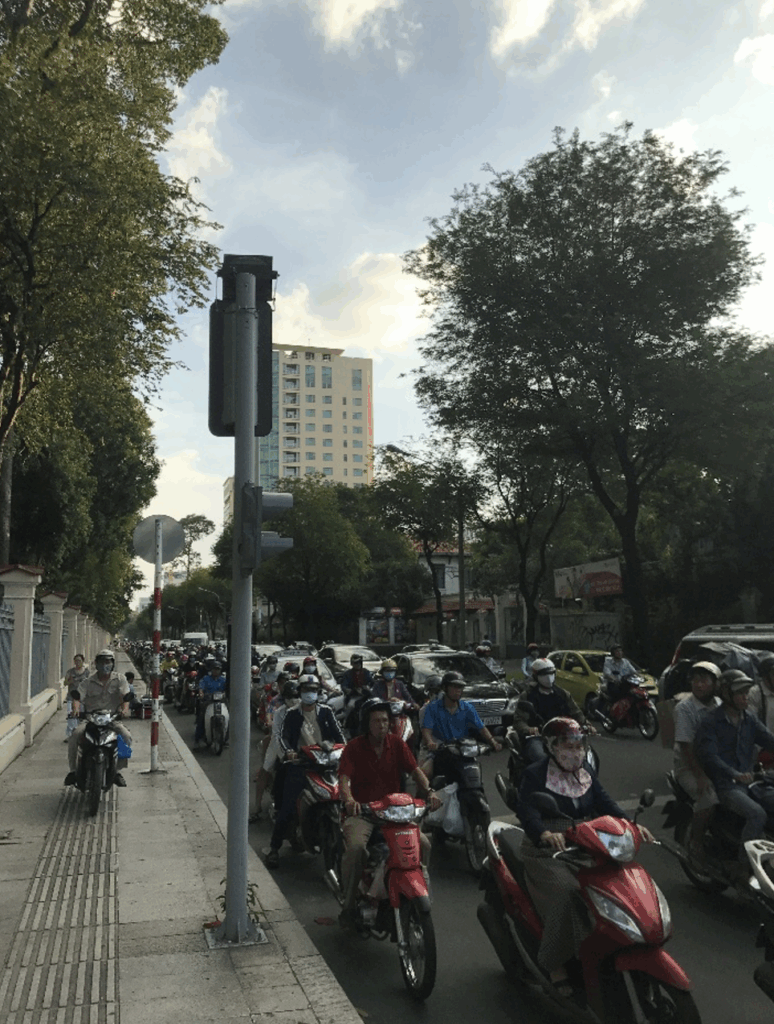
Above: A glimpse of everyday life in Saigon
With one potential career pathway eliminated, I headed back to D.C. to settle into some normalcy for the first time in two years. I started working as a contractor with a small program at the U.S. Department of Commerce called SelectUSA. I unknowingly began my pivotal shift to data and analytics there, not realizing what opportunities this would end up opening for my career.
SelectUSA is dedicated to facilitating foreign direct investment (FDI) in the United States. Think of a Japanese-owned car company setting up a manufacturing plant in the South: That’s the type of greenfield FDI that the program was trying to facilitate to create jobs and bring investment into communities across the United States.
As a part of the investment research team at SelectUSA, I provided analyses for companies that were looking to invest in the United States but needed guidance about where they might be most successful. Our team of analysts would take a huge variety of economic and demographic data and use them to create customized reports for these companies.
In that role, I immediately gravitated to the elements of data visualization, which combined a couple of areas that I really enjoy into a single field. I usually describe data viz as being a wonderful balance of left-brain and right-brain activities, combining quantitative analysis with aspects of graphic design. You’re not only giving your users information but also helping guide them on what to make of it. I had no idea this field of data visualization existed prior to joining SelectUSA, but I immediately loved it and especially enjoyed having the opportunity to learn Tableau.
Over my tenure working with SelectUSA, I jumped into the role of project manager, managing both a team of research analysts as well as the creation of some of the organization’s larger research projects and resources. After a few years, I formalized this by getting my PMP certification for project management.
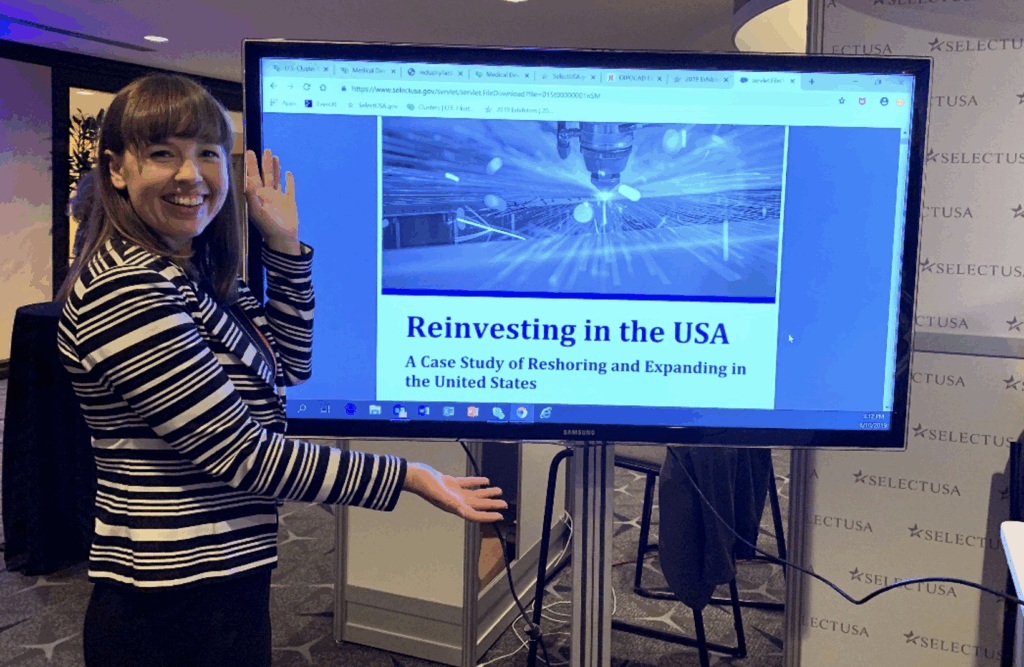
Above: Celebrating the release of a report that I cowrote for SelectUSA
Just as I passed the PMP exam and got the certification, a job opportunity arose for me to move back to the west coast to work for Nike’s North America supply chain program. A friend from high school (surprisingly enough!) posted on LinkedIn about his team looking for a data visualization engineer, and I jumped at the chance. You never know what might pop up on your LinkedIn feed!
While it was not easy to leave D.C. and my team at SelectUSA, I was thrilled for the opportunity to move to Portland, OR to become a full-time Tableau nerd.
At Nike, I worked as a part of a team that served as an in-house data consulting team of sorts to provide data and analytics solutions for the North America-specific programs working on their stores, direct-to-consumer sales and sustainability efforts, among others. I helped their supply chain teams answer questions such as where sneakers were being sold, how long orders took to get across the country and if people’s Christmas presents were going to show up on time.
I also got to meet a new data community in Portland through the local Tableau User Group, which was run at the time by some people from a little company called InterWorks. A couple of years later, at the encouragement of one of those InterWorkers, I filled out the Create Your Own Role application and ended up getting hired as an Analytics Architect. Yet again, the best “networking” happened when I wasn’t even trying.
Now, my role as an Analytics Architect at InterWorks really unites a lot of the different skillsets that I’ve developed over the course of my career: Bringing my curiosity and client service focus from my earlier foreign policy days together with project management experience and my relatively newer technical BI skillset. I get to assist all sorts of clients in solving whatever data problems they may be facing. In my first six months here, I’ve already had the chance to create new dashboards, help establish organizations’ data governance and Tableau governance frameworks, and continue developing my analytics skills with tools like Sigma.
Sure, my career has taken a pretty different path from what I envisioned for myself in high school, but it’s been incredibly fulfilling to have the opportunity to keep learning and building on my experiences to reach where I am now. What’s more, it’s amazing to see how my experience is not alone among my colleagues in taking a winding path to get to InterWorks. Each of us has taken our own journeys to get here, and we as a company are all the better for it!
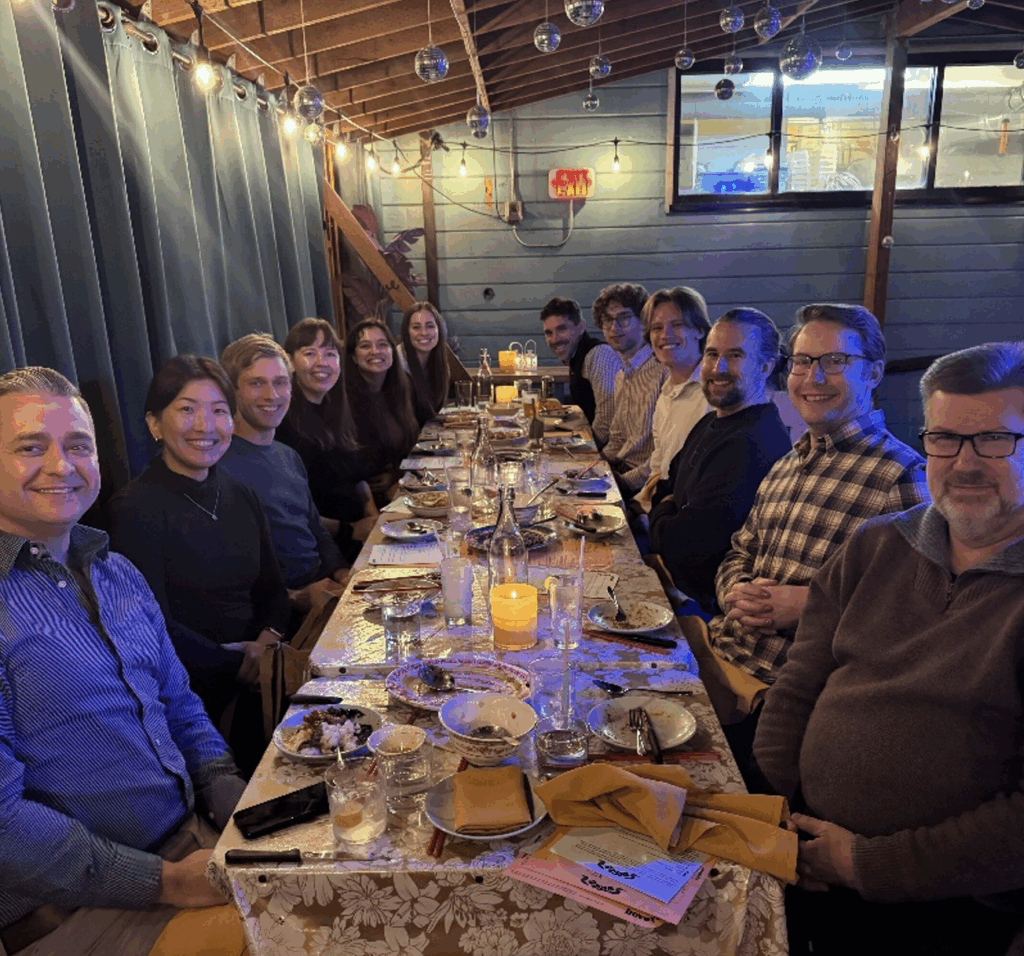
Above: A holiday dinner outing with the PDX office
Related