
I had the pleasure of attending Sigma‘s inaugural Workflow conference this month, where I met more of their team, shared excitement with enthusiastic customers and got a deeper look at a tool that is genuinely shaking up how we think about business intelligence.
Getting a window into their product left me positively stunned. Many of us left not only rethinking our workflows but also our place as analytics professionals in knowledge work at large.
AI Apps: Buzzwords or Reality?
I’ll be honest: Seeing everything tech-adjacent marketed as AI these days has gone from eye-catching to eye-rolling for most consumers. When I heard Sigma was rebranding Data Apps to AI Apps, the cynic in me saw a marketing stunt at play. It reminded me of Power BI branding its preferred report sharing mechanism as “Apps.” While Power BI apps are a wonderful feature of the platform, they can hardly be described accurately as applications. Originally called “Content Packs” (a name that makes total sense), they were renamed to “Apps” at a time where that was a selling buzzword, and everyone was looking to rebrand anything they could as an application.
What I’ve learned by building my first app in Sigma, and now from attending Workflow, is that Sigma is going far beyond marketing. Both the “AI” and “App” components of the product speak to such native platform functionality that I can imagine it becoming increasingly difficult to distinguish a well-designed dashboard from an AI App.
From learning how to call LLMs within native Sigma functions to seeing the roadmap for natural language prompts that yield agentic development of visual elements in a Workbook, the conference changed my view. AI is so natively embedded throughout the platform that branding all output as AI-related actually seems fair. Similarly, with core Workbook functionality including write-back, input tables, action sequences and approachable UI/UX features, everything built in Sigma can be designed as an app.
How BI Developers Can Stay Relevant in the AI Landscape
So naturally, many of us are left asking, “Where does that leave me? Is AI coming for my BI developer job?” I had this conversation with a colleague post conference, and the only encouragement I could honestly offer is that we’re all in this together. If agentic AI can replace the full suite of analytics professionals, then no industry is immune; and society faces much bigger questions about what to do with all this time we’re saving.
But in lieu of feigning foresight into humanity’s biggest open questions, here is my main takeaway (in quote form) for analytics professionals looking to stay relevant alongside their AI counterparts:
“We have to go beyond reporting the news to doing the job.” – Greg Bonnette
Emerging agentic AI tools are positioned to do things. Paired with Sigma’s app capabilities creates new opportunities for solving problems. Learning how to work with these tools and transcend read-only dashboarding is the natural next step in the BI industry.
Doing the job was the central theme of Field CTO Greg Bonnette’s best practices session, where he provided frameworks for approaching app development. Applications go beyond reporting the news by facilitating significantly richer user interactions than a dashboard. However, that heightened UX demands thoughtful product design, which he outlined using a B.U.I.L.D. framework seen below.
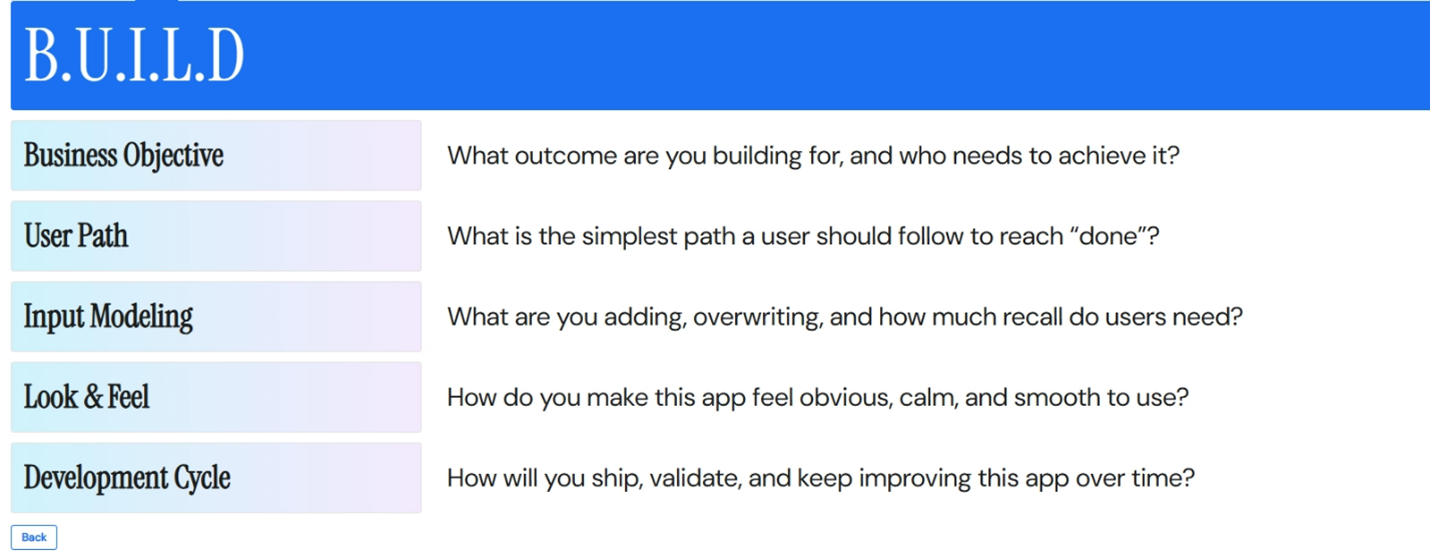
Shifting from Dashboards to Apps
Doing the job requires a different discovery and development approach than reporting the news. Greg had us imagine the impatient child in the backseat of a car, asking “Are we there yet?” to our stakeholders during discovery. “And then what happens? And after that?” We need to approach reporting projects differently, fighting our way to the broader context of what a dashboard will be used to actually do. If we’re already building the dashboard in Sigma, chances are AI App functionality can go much farther than the stakeholder anticipates.
My pipeline forecasting app was just scratching the surface on doing the job. This app took what was a disjointed process, combining CRM updates, dashboarding and further data consolidation into a stored output and brought it all into one place. But what if the app was the CRM? That’s the kind of question we need to start asking on these projects. It’s time to think bigger and, to borrow another well-worn tech buzzword, to disrupt.
Learning App Development Best Practices
When designing my first Sigma app, I found myself drawing on my experiences as an app consumer to imagine what would feel natural to a user. It was one of those projects, like a home DIY situation, where I found myself thinking, “I bet there’s an established way to do this that is way better.”
Greg’s session validated that instinct, putting useful terminology and design frameworks to what had otherwise felt like semi-organized chaos. For example, he named the distinction between linear user flows (like a loan application, moving from one step to the next) versus hub-and-spoke flows (like a forecasting process, where users bounce between levels before completing the journey).
Another key insight was on appending instead of overwriting data. When setting up actions on input tables, users “deleting” data should only feel like deletion. While Sigma supports row deletion in action sequences, best practice would be to add a delete flag and filter out data to retain historical data ~90% of the time. It’s a small thing that matters at scale.
These are only a few examples meant to illustrate that applications call for different best practices than dashboard development, and we should leverage the existing knowledge-base of the developer community as we make this transition. While I certainly learned a ton more like this in his session, my bigger takeaway was that this learning path requires more than an hour with a seasoned pro like Greg.
Time to Invest in the Right Skills for the Job
We as analytics professionals, alongside our employers, need to invest in app development expertise to achieve the potential that a tool like Sigma affords. Whether that means hiring staff within analytics teams with product development backgrounds or upskilling existing staff where possible, these two worlds are colliding rapidly. If we are successful in replacing an enterprise CRM with a Sigma AI App, we better build it correctly. When a dashboard goes down, it’s inconvenient. When a business-critical app goes down, that’s a different responsibility entirely.
In a past life, I had a meditation teacher who before facilitating transformative week-long silent retreats would enthusiastically say, “Let’s go shake some cages.” I can imagine a similar goal on the part of Sigma’s team coming into this conference, and I think they hit the mark. If you’re in analytics and not rapidly rethinking your tools, processes and skillsets in today’s environment, then you’re not paying attention.
While us humans still play a major part in the knowledge-work economy, we may as well build some cool stuff.
Related
