
Every private equity firm we speak to runs some of the most sophisticated investment operations in financial services, and almost all of them do their quarterly reporting in Excel. A senior analyst spends three to five weeks each quarter pulling data from the fund administrator, the portfolio companies’ accounting systems, the property manager and the CRM, then reconciling it all into a pack for the investment committee and the LPs. By the time the pack lands, the numbers are already ageing.
We kept seeing the same three problems underneath it. Reporting takes too long because it is rebuilt by hand every quarter. Definitions drift between teams, so “called capital” in the IR deck does not always match “called capital” in the fund model. And when firms bolt an AI chatbot onto their data, it produces answers nobody trusts, because the model is guessing at what the metrics mean.
So we built PE Intelligence: an accelerator that takes a mid-market fund from scattered source systems to a live, governed analytics platform in six weeks. It runs on Snowflake, dbt, Sigma and Anthropic Claude, and it exists because we believe the barrier to good fund analytics is no longer access to data. It is trust.
One Governed Model, Defined Once
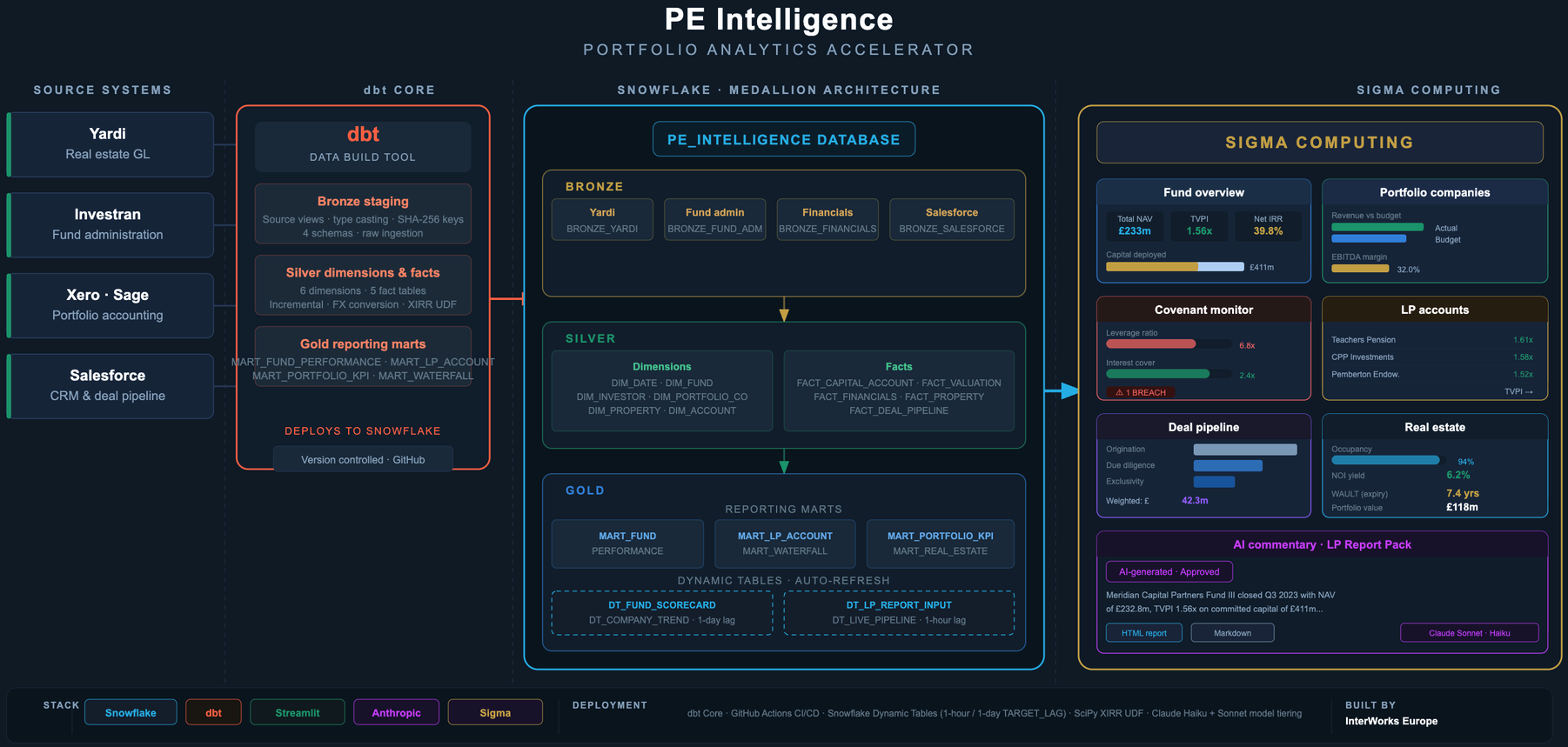
PE Intelligence connects the systems many mid-market GP already runs: Yardi for real estate, Investran or Allvue for fund administration, Xero or Sage for portfolio company accounts and Salesforce for the deal pipeline. Data lands in a bronze layer in Snowflake, then flows through a dbt-built dimensional model into gold reporting marts. More than 40 tested, version-controlled models handle the unglamorous parts: FX conversion, sign conventions, surrogate keys and a proper XIRR calculation that uses the actual dates of every capital call and distribution.
The point of all that plumbing is simple. TVPI, DPI, net IRR, leverage ratio and covenant headroom are each defined once, in code, with tests. The fund dashboard, the LP statement and the AI assistant all read the same definition. When a partner asks what drove the change in Fund III’s NAV this quarter, everyone is answering from the same numbers.
That single set of definitions is also what makes the AI layer trustworthy. We publish the model as a Snowflake semantic view, which means both Sigma’s AI features and Snowflake Cortex resolve natural-language questions through governed metric definitions rather than generating speculative SQL against raw tables. Ask two different tools the same question and you get the same answer. That sounds like a low bar. Most firms are not clearing it.
Live Dashboards the IC Can Actually Rely on
Sigma reads from Snowflake Dynamic Tables that refresh automatically (hourly for the deal pipeline and daily for fund and LP reporting). The Monday morning IC pack shows last night’s position, not last quarter’s.
The dashboards cover what a fund team actually needs day to day: fund performance with the full capital waterfall, portfolio company P&L against budget at line-item level, LP capital accounts with per-investor IRR, real estate NOI and occupancy, and a deal pipeline where probability comes from historical stage conversion rates rather than a BD associate’s optimism.
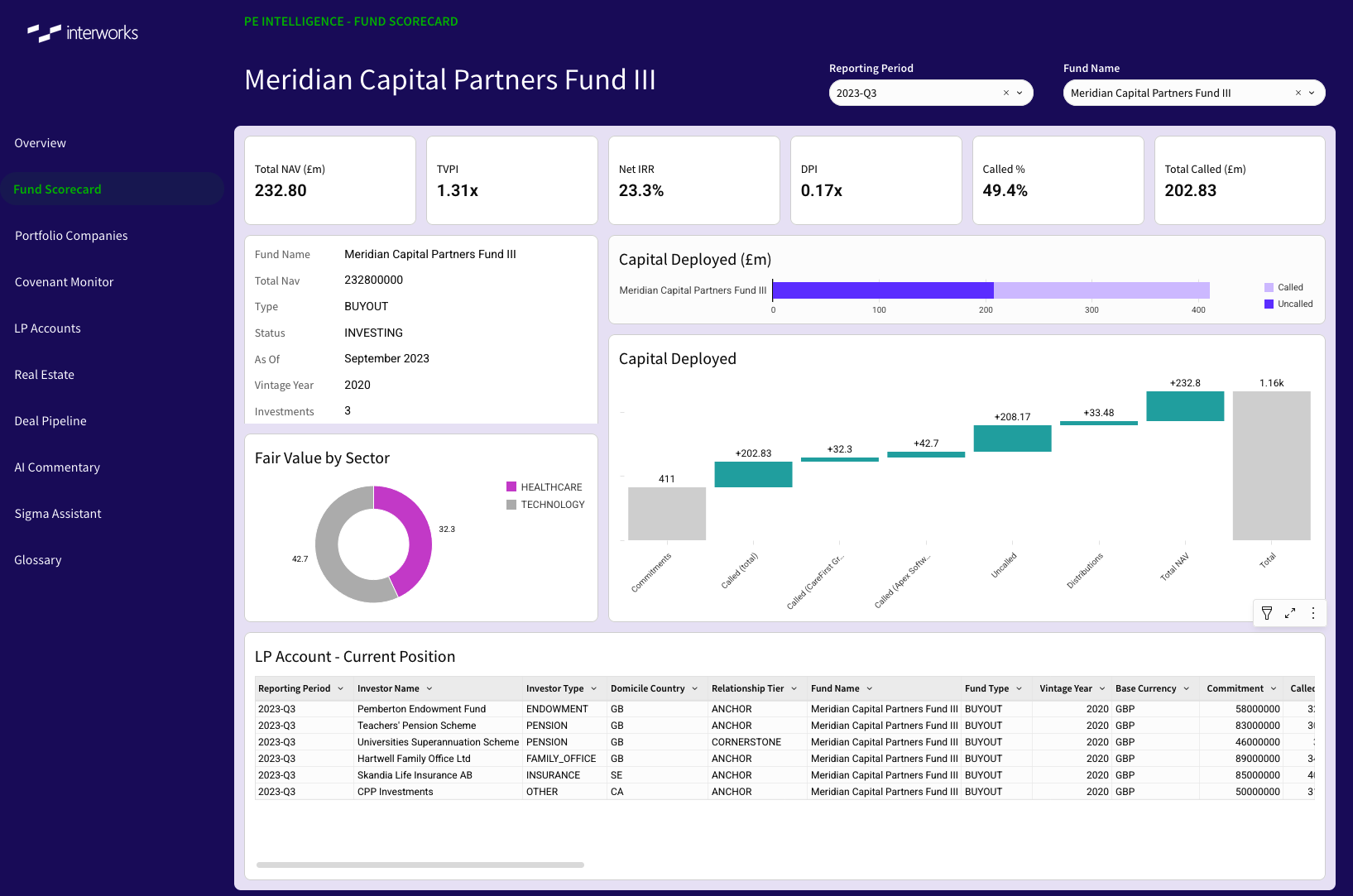
Above: Fund scorecard dashboard.
The covenant monitor tracks leverage and interest cover against each company’s thresholds, with a warning band at 90% of the ceiling. Deal teams see breach risk while there is still time to act on it, rather than reading about it in the quarter-end test results. Nothing about that feature is technically exotic. It just requires the data to be connected, correct and current, which is exactly what most firms do not have.
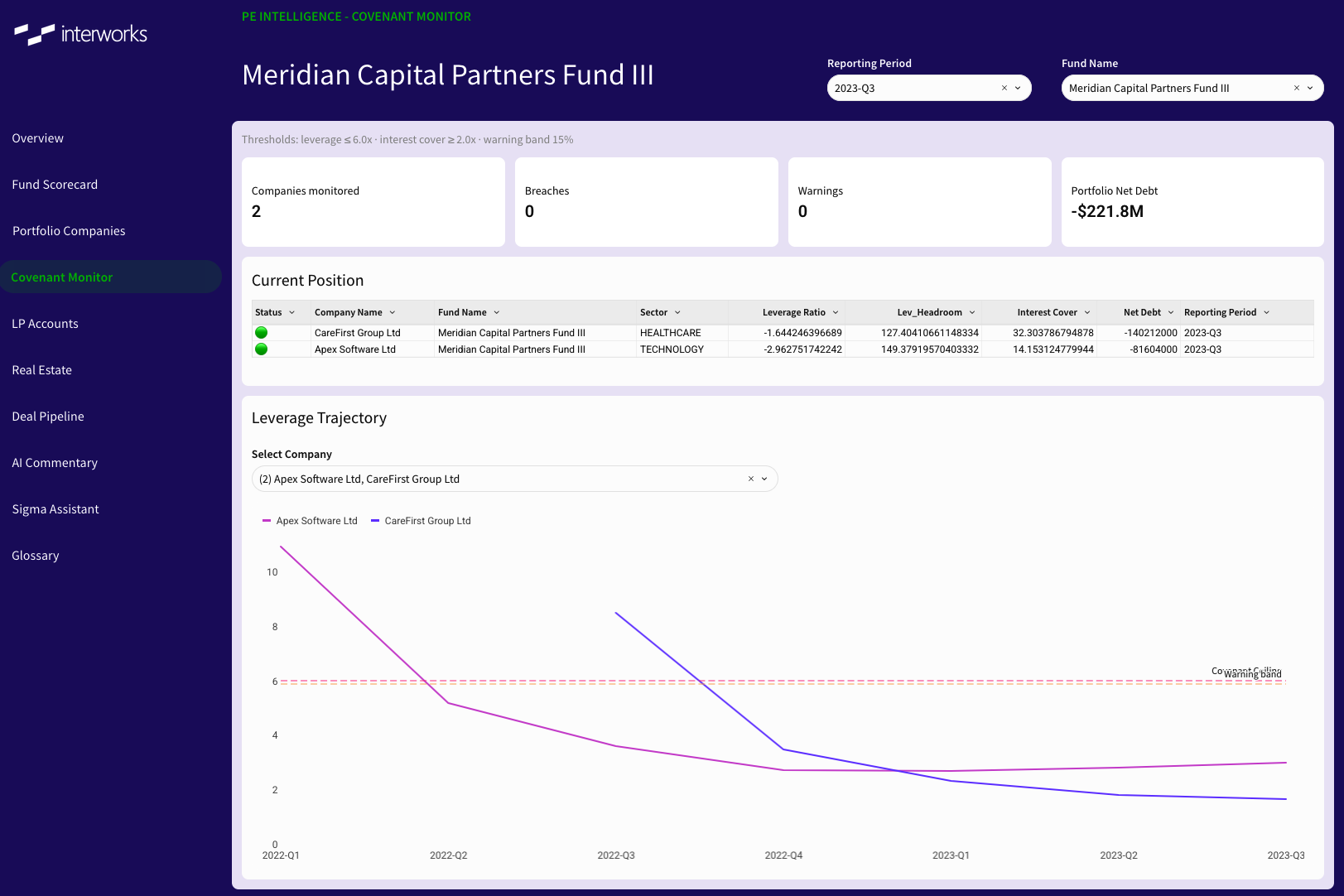
Above: Covenant Monitor dashboard.
AI Commentary with a Human in Charge
My favourite section, and the piece that gets the strongest reaction in demos, is the LP commentary workflow. Writing the quarterly LP letter is one of the slowest jobs in fund reporting: fund overview, portfolio highlights, then an individual account summary for every investor. PE Intelligence drafts all of it in seconds using Claude, grounded entirely in the live fund data.
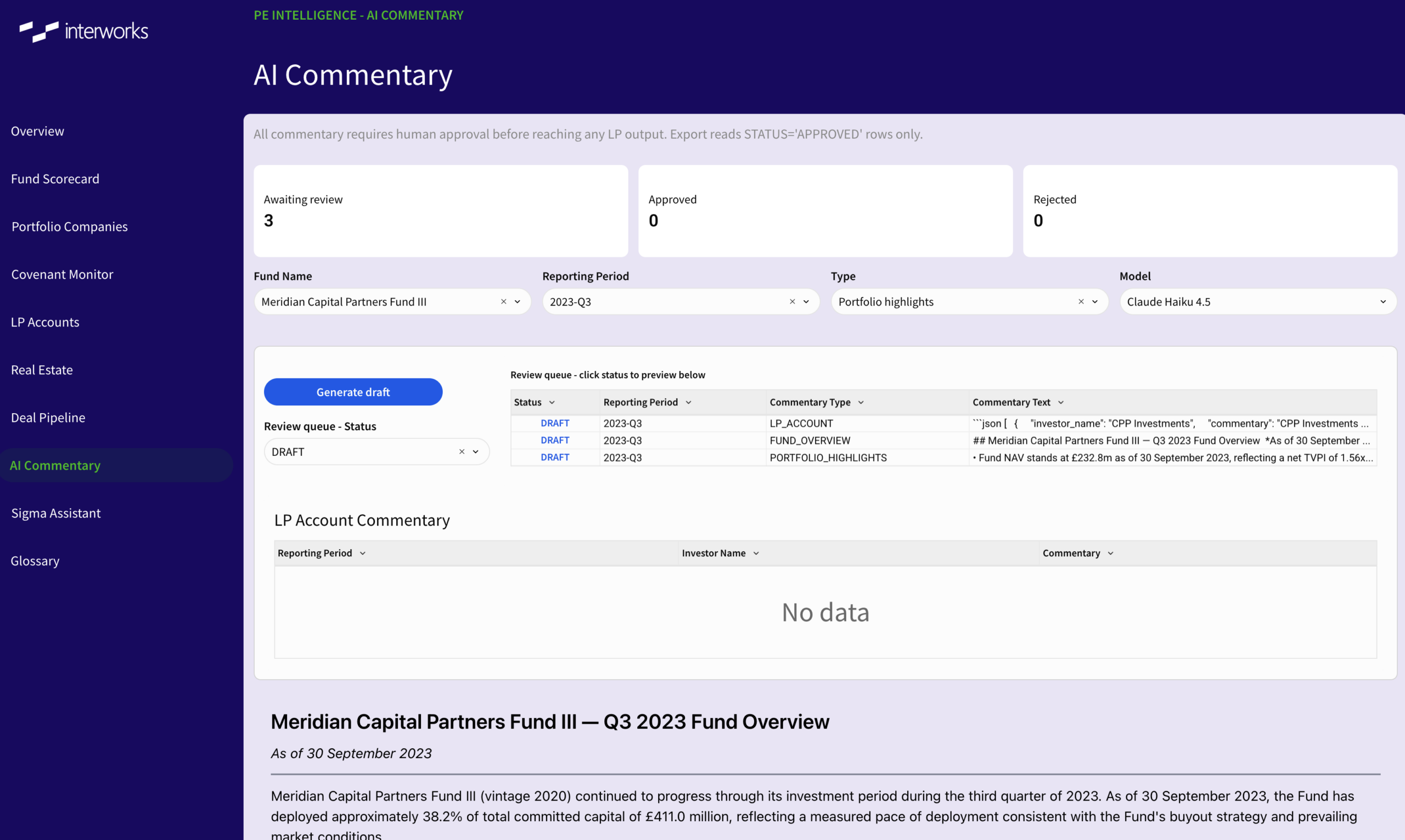
Above: AI Commentary dashboard.
Two design decisions matter here. First, we tier the models. The individual LP account paragraphs are formulaic, data-grounded summaries, so they run on Claude Haiku at a fraction of the cost. The fund overview letter carries more narrative judgement, so it runs on Claude Sonnet. Nobody should pay frontier-model prices to restate a capital account.
Second, and more importantly, nothing reaches an LP without a named human approving it. Every draft lands in a review queue with a draft status. A reviewer reads it, edits it if needed and approves it, and their name and timestamp are recorded against the row. The report pack only ever reads approved commentary. In an industry where a factual error in an LP letter can damage a relationship built over a decade, that approval gate is not a nice-to-have, it’s a must.
The result is that a reporting task which used to take a finance team the best part of a week now produces a reviewed, branded, per-LP report in under an hour, and the person signing it off spent their time on judgement rather than assembly.
Built as a Product, Deployed as Code
PE Intelligence is not a bespoke build we repeat from scratch for each client. The dbt project lives in Git. The Sigma data model deploys through the API. The dashboards, the semantic view and the commentary workflow are all part of one versioned codebase, which is why the deployment window is six weeks from signed SOW to a live LP pack rather than the six months a ground-up build would take. Each new fund is a configuration exercise: connect the sources, map the chart of accounts, load, test, go.
That approach reflects something we have believed at InterWorks for a long time. The value in a data platform is mostly in the parts nobody shows off: pipelines that do not break, definitions everyone trusts and an audit trail when someone questions a number in an IC meeting. AI has not changed that. If anything, AI has made the governed foundation more important, because a language model is only as trustworthy as the semantic layer underneath it.
If This Sounds Familiar …
If you work at a GP and your quarterly cycle still runs through a shared drive and a chain of Excel files, none of the problems above will be news to you. The interesting part is how solvable they have become. The warehouse, the transformation framework, the BI layer and the AI models are all mature. What was missing was a version assembled specifically for private equity, with the fund maths, the covenant logic and the LP workflow already built.
That is what PE Intelligence is. We would genuinely enjoy showing it to you, live data, AI commentary and all.
Reach out and we will put it in front of your team.
—
Kevin Pemberton is Managing Director of InterWorks Europe. PE Intelligence is built on Snowflake, dbt, Sigma and Anthropic Claude. InterWorks is a Sigma Elite Partner.