
This blog post is AI-Assisted Content: Written by humans with a helping hand.
Summer means a lot of different things to different people. For InterWorks, it’s a particularly exciting time as we bring on a new class of summer interns. While we certainly employ interns throughout the year, summer marks the beginning of our annual internship cycle, bringing in new faces and talent. Some cool aspects of our internship program that I’ve personally seen throughout the years are:
- Our interns do meaningful work while they learn. No scut or busy work here. We believe the best way to learn is to do things as they actually are out in the field, and our interns always rise to the challenge. They are equally valued members of the InterWorks team.
- Thanks to point number one, our interns often continue on at InterWorks full time or find themselves great positions at notable companies.
- Even experienced people at InterWorks who have been here for years are better off for having interns around. Much is made of what interns receive from this experience, but I’m here to tell you that we get just as much from them. They possess incredible energy and ideas that help keep InterWorks a vibrant place to work.
This summer’s crew includes Colby Schroeder, IT Intern and a senior-to-be at Oklahoma State University (OSU) studying Management Information Systems; Mark Johnson, BI Intern and an OSU grad student in his late 30s who has lived about five lifetimes before landing in Stillwater; and Jackson Moffatt, IT Intern who traded a music education degree for a career in tech after nearly three years working in OSU’s IT department. I sat down with all three to hear where they come from, how they found InterWorks, what interests them about tech and what they’re hoping to get out of the summer.
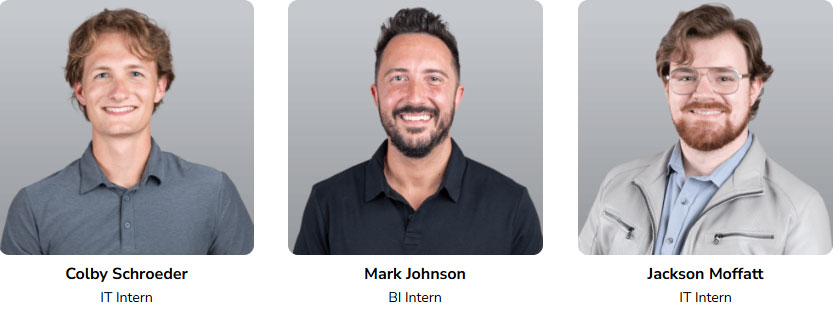
Q&A with Colby, Mark and Jackson
Q: Who are you, where do you come from, and how did you end up at InterWorks?
Colby: “I was born and raised in Edmond, went to Edmond North High School, and I’m up here in Stillwater finishing up my degree in MIS. I graduate this fall. As far as how I found InterWorks, I was looking for an internship, and my father actually knew Behfar from high school. He said I should probably see if there was an opening. I did, applied for it and got it.”
Mark: “My story is kind of crazy. I was born in Oklahoma City, and I’m a triplet, actually. We grew up always involved in the church. When we were about 16, we left because the pastor was an alcoholic and it turned into a whole scandal. Around that same time, I started taking concurrent enrollment classes, started out at the University of Central Oklahoma (UCO). I was really good at artwork and that kind of stuff.
But because we grew up so sheltered, and because I didn’t realize I had addiction and alcoholism in my family, whenever I started hanging out with college kids it was kind of this perfect storm. I was a drug addict and an alcoholic from the time I was 18 until I was 29. I finally went into detox and sober living when I was 29, totally turned my life around, spent about three years in sober living, went into leadership in the ministry and spent a ton of time helping other guys get sober. I really fell in love with recovery.
After I moved out of sober living, I wanted to move back and be the good son and brother and nephew that I was never able to be in my 20s. I ran into my grandma at Thanksgiving and asked if I could move in with her for a bit. She said two months, and by the time those two months were up she asked me to stay forever. I told her I’d be there as long as God wanted me to be. Not too long after that she had to have a triple bypass. So there I was, a few years sober, taking care of grandma on a 20-acre homestead with cows and all the rest of it, just figuring out how to live life out there.
I started detailing cars at body shops because it was about the only work available, and because I was doing manual labor and taking care of grandma, it gave me flexibility to go back to school. I started at OSU OKC and figured I’d do addiction counseling since that made the most sense given my background. But that path was super limited. I thought: I already do so much of this in my free time; let me explore a little. I finished up my basics, got into the Honors College at OSU and eventually switched into marketing analytics. My sister’s been a professor up at OSU for about 10 years, so it was kind of an obvious choice.
She wanted me to do the BANDS program so I could do a 4+1 and come out with a master’s. I’m 37, so I was trying to figure out how to get a master’s degree as fast as I could in a field that’s difficult enough where there aren’t a million people graduating from it (ideally without taking out student loans). Everything with grandma worked out, she healed up well enough that I could move out after almost four years, and I moved up to Stillwater in August to do grad school in person. I just wrapped up my senior year of undergrad and the first year of grad school, and I’m lucky enough to be here for the summer on the BI side. I’ve got one more year of grad school starting in the fall.”
Jackson: “I was born in Edmond and grew up there. After high school, I moved to Stillwater and started out in a music education degree because I wanted to be a choir teacher. I quickly found out that wasn’t for me, though I kept singing in choir and doing opera for a few years. I just couldn’t find my niche.
I really was going to college just to be a teacher, so during COVID I got heavily into computers. I was doing technology research every day during quarantine, trying to find something to fill my mind. Eventually I landed an IT job at OSU and fell in love with it. I worked with CASIT for almost three years before making the move here.
In my downtime I still love to sing. I sing for my church, go on international tours and try to get into as many choirs as I can. On the work side, I love working with hardware. I’m a big motherboard troubleshooter. I like taking things apart, and I’ve built my own PC multiple times.
As far as how I found InterWorks, I was going through OCHire while I was at CASIT, but when I started looking for other opportunities I went through Glassdoor and LinkedIn. Nobody referred me specifically. I was just searching for IT positions in the area with the kind of development I wanted, and InterWorks kept coming up. The culture stood out right away, on social media and on the website. It felt like the dream school of applications, the one I really wanted even while I applied everywhere else. It worked out, and I’ve loved it so far.”
Q: What was it about tech or data that first interested you?
Colby: “It’s always kind of been my thing. My dad works in IT, so from a young age I was just surrounded by technology and had access to everything. It all really started because I wanted a computer to play games on, and he made me build my own. He also had a server at the house, and he said if you want to figure it out, you can make a Minecraft server. So I did, and I really found it interesting.
From there I worked alongside him on side jobs, and I started doing more and more technical stuff — actually working on networking, switches, all of that. The troubleshooting aspect of it really scratched my brain. I felt like I could do this for the rest of my life and never get bored, because it’s not like a factory job where you’re doing the same thing every single day. There’s always something different. I’ve been doing IT and networking stuff for about four years now and I’m still enjoying all of it.”
Mark: “We always grew up playing video games, so we were gamers from a young age. That was always fascinating, but we were also really creative. Just the idea of having a vision that you could bring to life through technology, and how these different games would execute, that was always super cool to me. My very first job was at GameStop. I also worked at the Apple Store for about three years, which was a really exciting time because Steve Jobs was still around and there was just this constant energy of new things coming out.
Then obviously during my 20s there was a bit of a hiatus from all of that. But as far as getting back into it in school, that was a purely practical decision trying to figure out what degree field made the most sense. What’s been cool about the timing is that right when I started school, AI was rolling out. Using these tools to bring a creative vision into reality, being able to use something like Claude and have it embed interactive dashboards and all that stuff. It’s just so cool. It lowers the barrier for entry for people who would never have been able to build their own webpage before. Now they’re only limited by their ideas, which is the best part of all of it. It’s kind of like we’re in the Industrial Revolution, but for AI.”
Jackson: “I didn’t have a ton of computer knowledge specifically when I was younger, but I’d always been somewhat of a gamer. From an early age, I was exposed to the Nintendo 64 and GameCube, and my family would try to fix those machines and take them apart. We’d take apart controllers, put on new grips and shells, and try to learn how the motherboards and vibration controls worked. I’d been curious about how machines worked from an early age, but I didn’t start building PCs until college.
I’d had a love for computers and gaming for a long time. I just didn’t know how to apply it until I got into IT. There was always a fascination with how a box of technology could turn into pixels on a screen, or into audio. I changed my major from music education to music industry for a while and worked with sound engineering, learning DAWs and composition software. It was theory for a long time before I actually got to apply it.
As far as favorite games, Ocarina of Time is the first one I remember playing, so that one stands out. Wii Sports and Wii Sports Resort are big childhood memories too, along with the LEGO Star Wars saga games. Those are the ones that started my love for what gaming and computers actually are.”
Q: What do you hope to get out of your InterWorks internship experience?
Colby: “Originally it was just going to be for the summer, and all I wanted was some experience. I’d worked with my dad for years, and even he said, you need to go somewhere else for a while and learn some other ways, get some experience with a more corporate environment. So, I was just going to get a little experience, make some money, and learn a lot. I wanted a position where every day would be something new that would make me more knowledgeable.
But even through onboarding week, I started thinking I might want to look for something more long-term here. I haven’t job-hopped a whole lot, but as far as I can tell, InterWorks seems like a really good place to be, and they treat their employees really well. Employee morale is emphasized in a big way here. Three to four weeks in, I’m starting to get the hang of the systems where I can go through the day without feeling totally lost, and it’s going good.”
Mark: “I would probably rank what I’m hoping to get out of it as relationships first, then skills, then experience — though you could interchange skills and experience. Relationships first because there’s a phrase we have in recovery: “It’s all about relationships.” Just from life experience, those are the things that last the longest, and that’s always where you’re going to get the most return on investment. Who knows what’s going to happen in the world of tech — everything is so crazy all the time — but relationships will outlast all of that.
There are so many brilliant, interesting and honestly kind of wacky people around me here. Everyone seems to have been here for 10 years or more, and whether it’s asking about AI, IT, BI or just how to get the most out of the internship, everyone has really awesome advice and clear direction. As far as tasks I want to accomplish this summer, the biggest thing on my radar right now is getting through the Claude Architect exam. It’s certainly an uphill battle, but it’s a great goal to be working toward. And honestly, I would love to stay on at InterWorks after the internship if that’s something that worked out, especially since I’m hoping to stay in Stillwater with family here.”
Jackson: “I’d say I’m in the more broad scope. I wanted to learn as much as I could about how a real IT job works outside of the university, with different systems and a third-party structure. I wanted to see how IT professionals who’ve been doing this for a decade actually work: what their workflow looks like, what systems they’re in, how they get access and permissions. I wanted to learn everything.
I still have an interest in hardware repair on the side, but here it’s been fun learning the inner processes of remote work. This is my first time ever working remote or using remote management software. My previous position was all in person, walking to the building for every single ticket. Having a tool like Slack, where you can talk to anybody at any time, was a big change. It taught me how efficient people can be, and I feel like I’ve become a lot more efficient as a worker because of it. I’m just trying to soak up as much as I can.”
Q: Where do you see your career going from here?
Colby: “That’s a really hard question. I didn’t even know if I wanted to go to college at all. I spent a solid year debating it, and honestly I think I ended up going because I got so hung up on thinking about what I wanted that I just kind of rolled into it. I say I want to do IT, but if in a few years I get bored of it or find something else that interests me, I don’t know if I want to be locked into one path. I kind of live in the thought that I have no idea what’s going to happen, and I go day by day.
Mark: Just with the momentum of everything right now, getting specialized in AI — however that looks — seems really valuable. The field changes so much that it’s hard to point to a specific job title or path I’m shooting for. Man makes plans and God laughs, right? But because AI gives me energy, because I find it exciting to talk about and show off what you can build, that’s the direction I want to go. I’m at an age now where I’d rather gravitate toward things that give me energy than things that drain me. If it’s something I can be excited about and make money on at the same time, that’s the combination I’m after.”
Jackson: “I’m still looking at potential pathways. A few things have stood out, like the basics of networking and cybersecurity, which I find really interesting, though I’m not sure yet if that’s the specific path I want. I still want some kind of hardware repair in my future because I love opening machines up and figuring out what’s wrong with them. I also want to keep doing remote work and some help desk, because I enjoy those problems and solving them.
For now, I’m just looking at what’s open to me. I’m still very much in a learning phase where everything is available and I have to start narrowing it down. But I love that there are so many potential paths.”
Q: If time and money were no object, what would your dream life look like?
Colby: “Living on a homestead and doing cattle. My family here in Stillwater actually has a farm and we do cattle. Working outside, using my hands, being on the land — I never get bored of it. There could be a problem with the tractor, or the cows need tending to, and I always want to go do it. There’s never an “ugh, I don’t want to deal with that.” If money was not a concern, running a homestead and living on full land is where I would spend the rest of my life.
Mark: Funny enough, when Colby said that, it reminded me of something. At our first semester case competition, I met this tech CEO who had a homestead but had incorporated tech into all of it. His sprinkler systems would test the soil for nitrogen, phosphorus, potassium on a timer, and he had dashboards for everything going on on his property. I thought it would be really fun to build some kind of AI homestead. How do you take those two things and bring them together?
But if I had all the money in the world, I would still be tinkering, because the creativity of humanity gets me going. I’d want to travel a lot. I’d want to see all the old megalithic architecture, anything that questions the historical narrative, and I’d want to see Antarctica. I’d be flying to Japan for sushi and Spain for steaks. And at the same time, just like Colby said, I love growing stuff and cultivating a little hobbit hole where you could raise a family. So, a little bit of everything, honestly.”
Jackson: “One of my best friends is actually working on this with me. We’re trying to build a tiny house community in the middle of nowhere in Oklahoma. It would be a nonprofit organization run out of that community, focused on wildlife conservation, with small festivals, lots of music and a coffee shop. It would be local, farm-to-table and mostly subsistence.
On the side, I’d want a big server area of my own, a home lab where I could self-host movies and everything else. Otherwise, what I’ve wanted for a long time is one big community of like-minded people working together.”
Q: What do you think you bring to InterWorks?
Colby: “Something that’s usually really valuable in anything I go into is my ability to problem-solve. People ask me all the time, how do you segment that out? Some people just think my brain is wired to troubleshoot, and that’s about it. But that’s probably the most valuable thing I would bring to InterWorks.
Mark: The first thing that popped into my head was a unique perspective. Everyone has a unique perspective specific to them, but because my path to getting here has been so much different than most people’s, I probably see the world a little differently or approach things in a unique way. What I’ve found, whether it’s group projects in school or anything else, is that a unique approach tends to produce some really interesting and unusual results on project work. And one thing that seems to resonate with people is novelty — something new that nobody’s seen before. That creates a lot of energy. Just because it’s new doesn’t always mean it’s good, and sometimes it’s just throwing a bunch of ideas out to see what sticks. But I think there’s something to be said for a very different path bringing something a little new or different to the team.”
Jackson: “I’d say I’m a warm, open presence. I like doing customer support, and I’m a patient worker. I don’t have some massive talent for diffusing situations, but I’m good at helping people stay calm when they’re going through an issue and letting them know we’re going to reach a solution.
I also really enjoy remote support, looking up how scripts and remote connections work, and going back through old documentation and old tickets to see how someone else solved a similar problem. It’s less about being a curator and more about the research itself, seeing how a person solved something and who they asked. That carries over into patience with troubleshooting my own technology too.
When I trained students at OSU as team lead, it was interesting to watch them work tickets. A lot of them had soft skills already, but they didn’t always know how to apply those skills on a call, and they’d get flustered. Helping them get comfortable talking to people was interesting to watch. If I had to sum myself up, I’d say patience, optimization and research.”
Q: What do you do outside of work?
Colby: “The homestead is one of the biggest ones, taking care of the cattle and all that, but I also storm chase. The season’s basically over now, and honestly it was kind of a flop this year with almost no tornadoes. Outside of that, I have a big interest in cars and mechanics. Back in high school, I actually started my own little car mechanic business, just me, working on a few cars for side money. I still enjoy it a lot. Right now I’m restoring a 1971 Chevy Nova with an LT1 swap, and I’m deep in the wiring phase, which is a lot.
Mark: I’m kind of a hippie — a hippie that likes to work out a lot. I spend a lot of time in the gym, but I love meditation, natural remedies, homeopathics, learning about all that. With my history, I definitely prefer natural remedies over prescriptions. I love to garden. And funny enough, for as much as I love all the alternative, hippie-leaning stuff, I didn’t actually try yoga until the wellness day we had here at InterWorks. And, of course, I immediately fell in love with it. I’ve been going over to Red Earth Studio to keep learning. Other than that, I still like doing creative stuff when it comes to artwork, so that keeps me busy too.”
Jackson: “I’m a big animal lover. I have two cats, and we care for some stray cats around our place too. I live with my girlfriend and we love taking care of them together. I try to volunteer when I can, though I’ve been so busy lately with moving into a new place that I haven’t had much time outside of work.
When I do have time, I game a little, and I have a D&D group I play with regularly. I like doing house chores; honestly, it calms me down some days. On a perfect day, I’d get in some gaming, watch a movie with my girlfriend and just listen to music on a good set of headphones, picking out the details in songs. It’s a meditative thing for me.
Outside of that, it’s animals, singing and rehearsing with groups, and learning new music, especially with different people. I’ve done some professional recordings, and I really enjoy those days, since there are so many people coming together for one project.”
More from Colby, Mark and Jackson Soon!
Colby still has one semester to go before he graduates, Mark has another full year of grad school ahead starting in the fall, and Jackson brings nearly three years of hands-on IT experience from OSU to a completely remote, third-party support role for the first time. All three are already making their mark here at InterWorks, and if the first month is any indication, the company is in good hands with this group. We’ll be checking in with them over the summer to see what they’re learning and how they’re growing, so be sure to stay tuned!