
This blog post is AI-Assisted Content: Written by humans with a helping hand.
Building a secure data lakehouse in Snowflake is only half the battle. The harder problem is getting that data in front of business teams without exposing sensitive personal information or requiring everyone to learn SQL.
A hands-on lab at Snowflake Summit 2026, “Activate Snowflake Data With ThoughtSpot Agents,” tackled that problem directly, building on top of a separate lab where participants had already set up a governed Snowflake data lakehouse with masking policies, role-based access control and a Cortex Agent for natural language queries.
Here’s what ThoughtSpot adds on top of that foundation, and how the pieces fit together.
Spotter vs. Cortex Agent
The earlier lab used Snowflake’s own Cortex Agent to handle natural language queries. ThoughtSpot’s AI analyst, Spotter, is an alternative that sits on the same governed Snowflake data but adds a fuller business-user experience: Dashboards, visualizations and shareable “Liveboards” instead of raw query results.
The integration announced at Summit lets these higher-reasoning agents operate directly inside Snowflake’s security boundary while keeping a single governed source of truth. Masking policies and RBAC set up in Snowflake still apply once ThoughtSpot is in the loop.
Two Ways to Connect Them
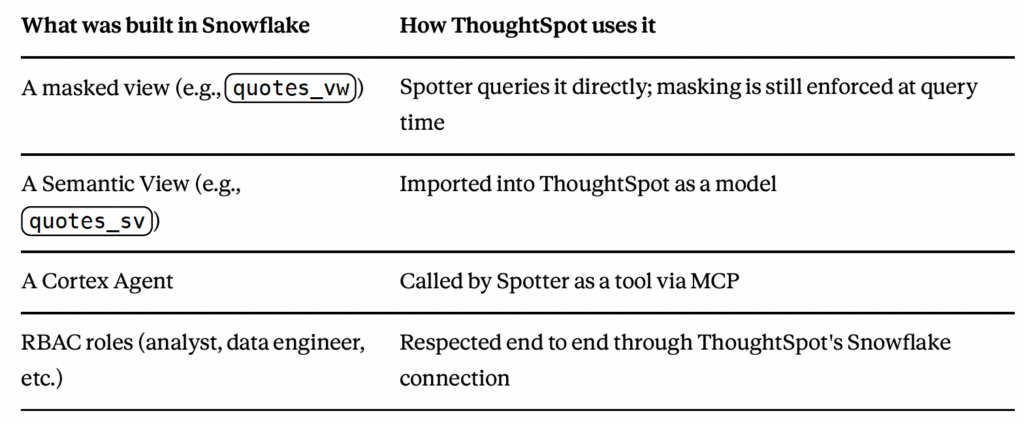
Model Context Protocol (MCP). Snowflake acts as the tool provider, exposing Cortex Agents, Cortex Search and Analyst services. ThoughtSpot’s Spotter acts as the consumer, invoking those Snowflake-managed tools to retrieve structured and unstructured data, then persisting the results as ThoughtSpot objects. This is the fastest path from a natural language question to a governed, shareable Liveboard.
Semantic View sync. Through an integration with Snowflake CoCo (Cortex Code), the two platforms now support bidirectional semantic management. A Semantic View built in Snowflake can be imported directly into ThoughtSpot as a model, and a ThoughtSpot model enriched with additional AI context can be exported back into Snowflake. Business logic and metric definitions stay consistent no matter which tool someone opens.
In practical terms: A Semantic View such as quotes_sv can be pushed into ThoughtSpot, or a model built in ThoughtSpot can be pulled back into Snowflake, without maintaining two separate definitions of what “an active deal” or “monthly revenue” means.
What This Looks Like Against a Real Setup
Getting It Running
Four steps cover most of it:
- Connect ThoughtSpot to the Snowflake account through Snowflake OAuth, so ThoughtSpot authenticates as the user and inherits their role and masking policies.
- Import the Semantic View by pointing ThoughtSpot at it directly; metrics and dimensions come across automatically.
- Turn business users loose on Spotter, where plain English questions return Liveboards rather than raw tables.
- Optionally wire it through MCP so Spotter can call an existing Cortex Agent as a tool.
Why It Matters
Three things stand out about this integration beyond the basic “it connects” pitch.
Governance travels with the data instead of stopping at the BI layer. Because ThoughtSpot connects through Snowflake OAuth, RBAC is respected automatically, and dynamic data masking still triggers at query time. Spotter only ever sees masked data, so sensitive information stays protected regardless of who’s asking the question.
The output is a dashboard, not a transcript. Natural language questions get converted into interactive, shareable Liveboards, which is a meaningfully different experience for a business user than scrolling through query results.
Business logic doesn’t fork. Because semantic definitions sync bidirectionally through Cortex Code, a metric defined once means the same thing whether someone is looking at it in Snowflake or in ThoughtSpot.
For organizations already running ThoughtSpot for dashboards, none of this requires rebuilding anything. It connects to the same governed data already set up in Snowflake, and business users get self-service analytics with no SQL, no data movement and governance enforced automatically. The foundation stays in Snowflake; ThoughtSpot is simply the layer that makes it usable by everyone else.
Related