
This blog post is AI-Assisted Content: Written by humans with a helping hand.
The first complex app I built in Sigma taught me more about architecture than it taught me about Sigma. It started simply enough: One input table, some additional logic on top, a button that wrote records back to the warehouse. Then complexity crept in:
- A new user type needed a separate view
- A logic step that needed to run before the writeback
- Another input that depended on the first one
Before long I had several custom SQL paths with duplicate code that could break with any upstream change. That’s not a Sigma problem. That’s an architecture problem. And it started before the first element was created.
Where Sigma Fits in the Stack
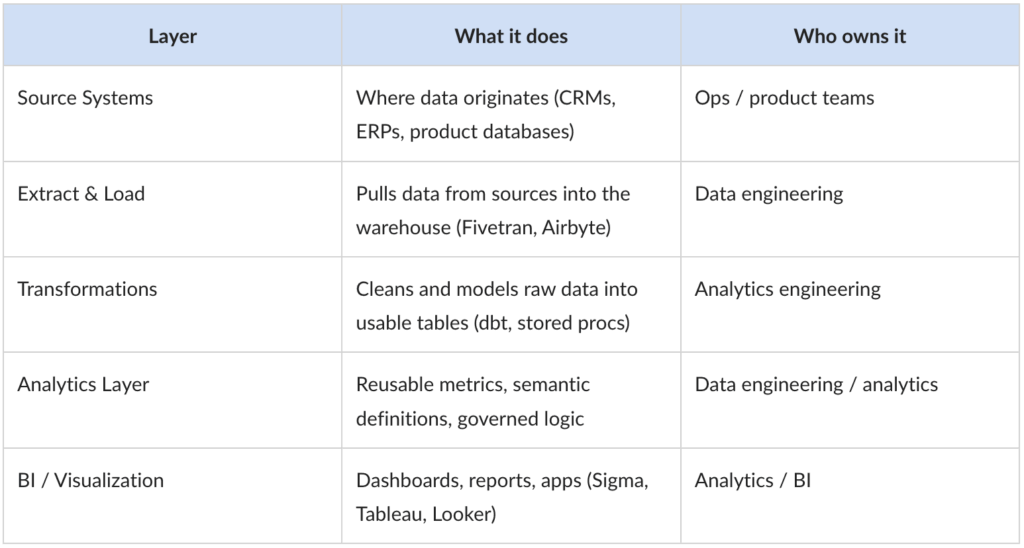
Each layer has clear ownership, versioning and testing patterns. The discipline in the middle layers is what keeps things maintainable. The challenge is when BI tools start absorbing logic that belongs upstream.
When Sigma Starts to Strain
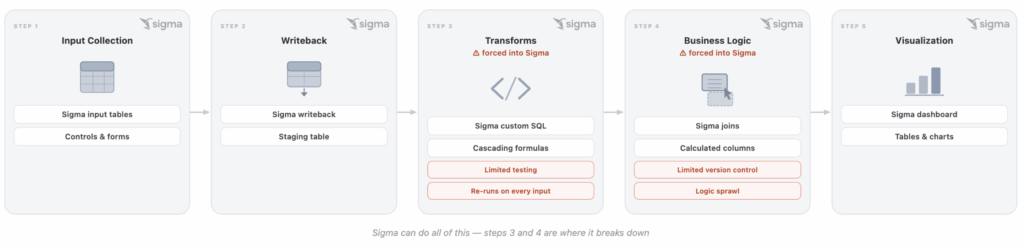
Sigma can handle a lot. A single workbook can collect user input, run SQL transformations, manage workflow state and display results. For smaller, well-scoped apps, that’s a feature.
The challenge is when complexity grows unchecked. Performance slows, logic scattered across dozens of connected elements gets hard to trace and making changes starts to feel risky. The workbook I described at the top is a real example. It wasn’t a Sigma limitation, it was an architecture that outgrew what any single tool should hold.
The Pattern That Actually Works
After building it the wrong way, here’s the architecture I keep coming back to:
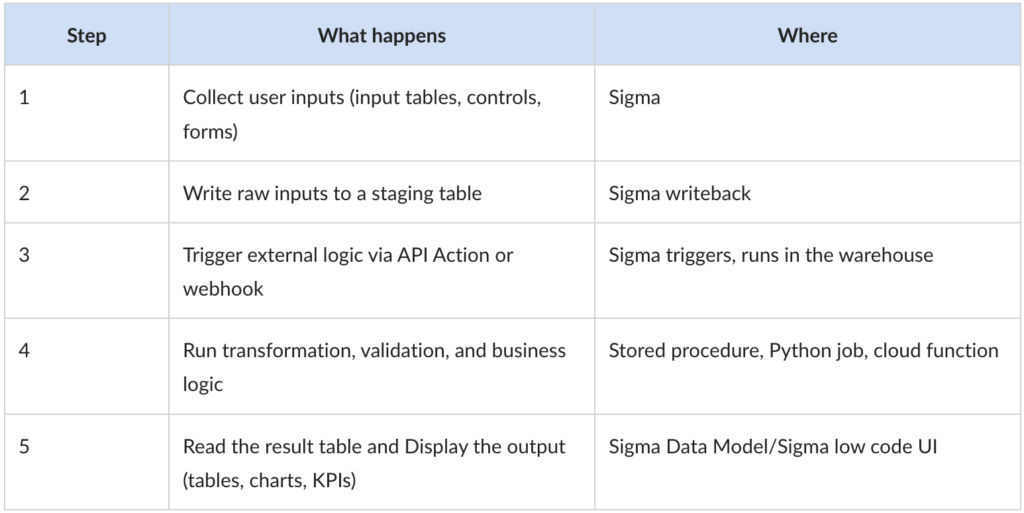
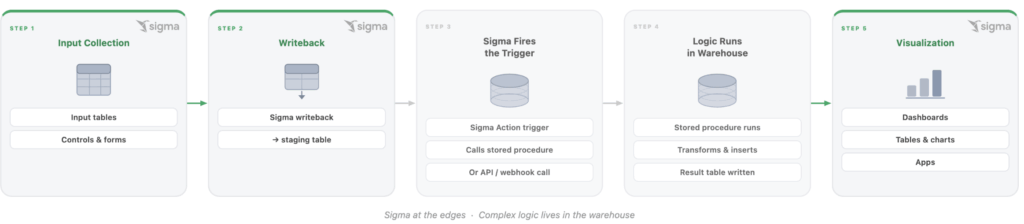
Sigma collects the input. The warehouse does the work. Sigma displays the result.
The Architecture That Holds Up
The pattern in the table above isn’t Sigma specific advice. It’s just good layering where each tool is doing what it is actually good at. Sigma collects inputs and displays results. The warehouse runs the complex logic. That division is what keeps the workbook from becoming a thing nobody wants to touch.
The complexity will come. The architecture determines whether that complexity stays manageable.
