
This blog post is AI-Assisted Content: Written by humans with a helping hand.
This week, I’m in San Francisco attending Workflow, Sigma’s inaugural user conference, and I can’t help but think back to 2011 and my first Tableau conference in Las Vegas. That event was small and intimate – just a few hundred attendees, well before the press fanfare that surrounded TCC 2013 in Washington, D.C. following Tableau’s IPO announcement.
The people in that room in 2011 were the early believers: practitioners who had found something that genuinely changed how they explored and understood their data, and who wanted nothing more than to share that with anyone who would listen. There was a rawness to the energy. Later, the Tableau community would take on an almost cult-like devotion; but in 2011, it was something simpler. It was just a group of people who thought they were watching something important happen and couldn’t wait to see what came next.
InterWorks was Tableau’s first Gold Partner in the United States and in Europe. We were there from the very beginning, and I’ve spent the fifteen years since working alongside the community that grew from those early days.
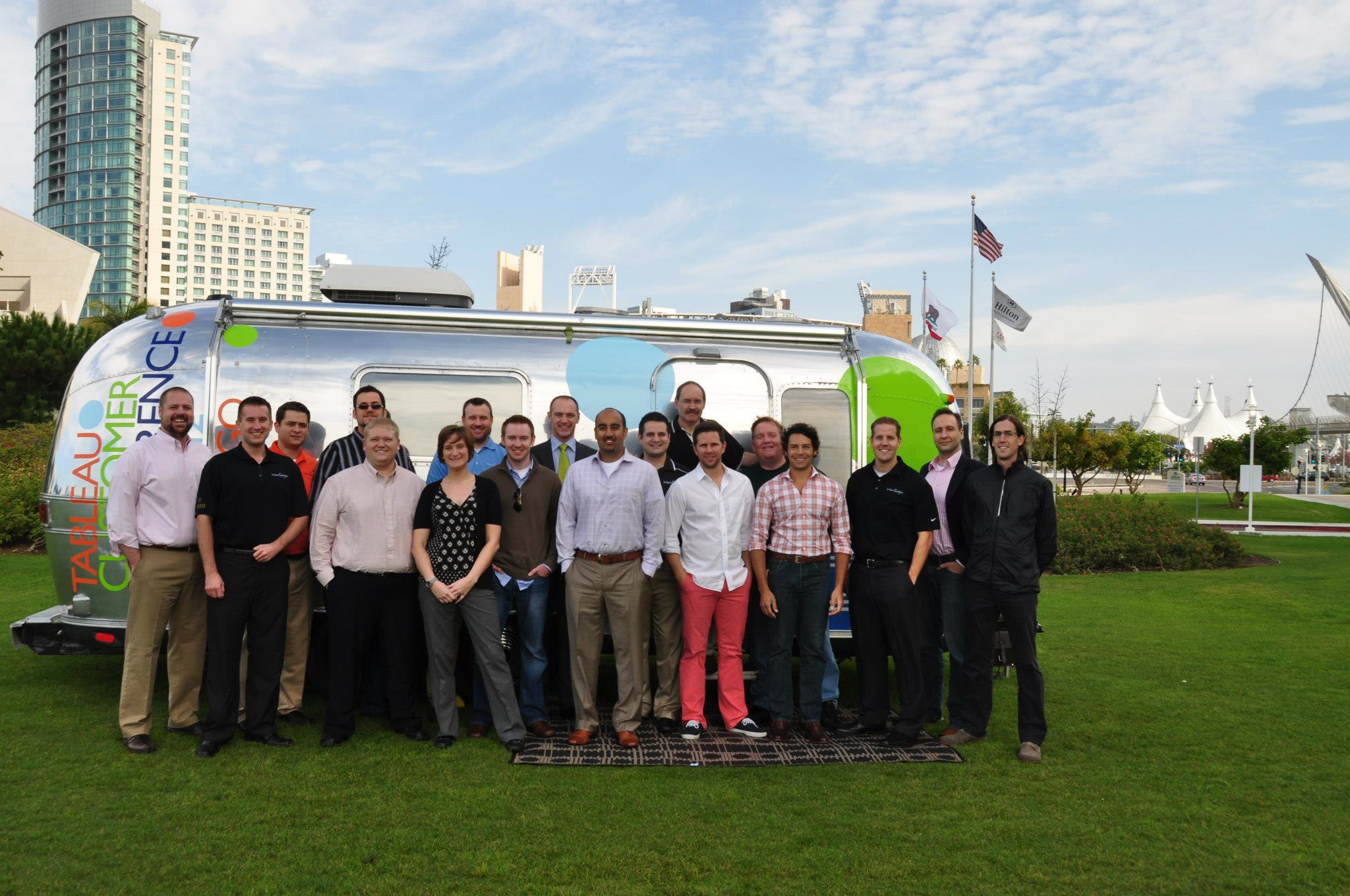
Above: Tableau Conference in 2012.
Preparing for Workflow this week, I sense some of that same early-days energy. Sigma is a genuinely different kind of platform — built natively on the cloud data warehouse, combining analytics with AI-powered workflows and governed business applications in a way that feels like a real step forward. Whether Workflow becomes its own TCC moment is anyone’s guess. But I do know we’re on the precipice of something much more meaningful than the self-service revolution, and that the organizations acting now will have a meaningful head start.
Which brings me to the story I’ve been wanting to tell. Because to understand where we’re going, it helps to understand where we’ve been.
The self-service analytics era delivered exactly what it promised. And the success of it created a new set of problems we’re still sorting out today.
To be clear: dashboards aren’t going away. They’re still how most organizations run the business week to week. What’s ending is the idea that you can scale analytics by scaling dashboards alone without an intentional approach to how your data is governed, how it flows and how it adapts to what’s next.
What Self-Service Analytics Delivered (and Left Behind)
For most of the 2010s, the story in data was about access. Get the tools into more hands. Democratize insights. Bring the data to the business. And it worked. Organizations that once relied on a small IT reporting team ended up with hundreds, sometimes thousands, of creators across the business.
But somewhere along the way, access became accumulation.
Organizations that set out to build a handful of key dashboards ended up with thousands of workbooks. Data sources multiplied without clear ownership. Teams calculated the same metric in different ways, and nobody could agree on which number was right. Governance, which was never the exciting part of the conversation, got left behind.
I’ve sat in enough exec sessions to recognize the next chapter of this story. A CDO or VP of Data walks in and says something like: “We have great BI adoption, but our leaders don’t trust the numbers, our engineers spend half their time maintaining pipelines nobody documented, and we’re paying for multiple platforms that all store overlapping copies of the same data.”
That’s not a failure of self-service. It’s what happens when you give smart people powerful tools without an intentional approach to tying it all together.
Then 2020 Happened. Then ChatGPT.
If the governance debt was a slow leak before 2020, the pandemic turned it into a flood – remote-first operations, distributed teams, cloud-first infrastructure. What might have taken five years happened in eighteen months.
Most organizations were still catching their breath when OpenAI released ChatGPT in November of 2022. By January, analysts estimated it had reached 100 million monthly active users – one of the fastest adoption curves we’ve ever seen. And just like that, the conversation in every boardroom changed. “What are we doing with AI?” became the question of the moment.
The problem is you can’t build trustworthy AI on top of ungoverned data. AI on top of fragmented, undocumented infrastructure doesn’t give you better answers. It gives you faster wrong answers, with more confidence. That’s actually worse than no AI at all, because now you erode trust even faster.
Since then, every client conversation I’ve been in has circled the same challenge: How do you move forward pragmatically when the ground keeps shifting? How do you cut through the hype and find the signal?
Part of the honest answer is that it wasn’t just about data readiness. In 2023 and 2024, the practical, enterprise-grade AI use cases weren’t fully there yet either. The technology was impressive, but the gap between “impressive demo” and “production deployment that drives a business outcome” was real. A lot of organizations made the rational decision to watch and wait.
That calculus is changing fast. In 2026, we’re seeing AI maturity accelerate in ways that are genuinely different — better tooling, clearer patterns for enterprise deployment and use cases that are starting to show real, measurable returns. This means the window for waiting has narrowed considerably. The organizations that have been quietly building the right data foundation are the ones who will be able to move quickly when the right use case is in front of them. The ones who haven’t will spend that time catching up.
The Shift from the ‘Right” BI Tools to Intent
Here’s what I’ve come to believe after fifteen years of client work: the organizations making real progress aren’t the ones who found the “right tool.” They’re the ones who stopped leading with tool selection and started leading with intent — what are we actually trying to accomplish, and what does the foundation need to look like to get us there?
A tool-centric approach says: “We need a better warehouse, so let’s evaluate Snowflake vs Databricks.” An intent-driven approach says: “What outcomes are we trying to enable, how does data need to flow to support those outcomes, and what does the foundation need to look like so this is reliable and repeatable?”
The tool decision comes later, and it comes out of that conversation, not before it. This is what we mean at InterWorks when we talk about Modern Data Infrastructure. It’s not a product or a stack. It’s a way of thinking about your data environment as a whole — starting with intent, designing for change, and building the trust that makes everything else work, including AI.
Getting This Right: 3 Modern Data Infrastructure Pillars
1. Focus on intent instead of tech.
This gets violated constantly. Tools are tangible, demos are exciting and vendor relationships make decisions feel easier. But the organizations that struggle most almost always started with platform selection before they aligned on what they were actually trying to accomplish.
Start with business outcomes. What decisions do your leaders need to make? What data do they need to make them with confidence? Define the metrics you’re going to run the business on, then design the architecture that supports them.
2. Design for scale and change.
The most expensive thing you can build is infrastructure that can’t evolve. The industry will look different in three years. Your org will look different too.
Modern patterns like Medallion Architecture, Data Mesh and Data Contracts aren’t magic words. They’re design approaches that help you separate concerns, clarify ownership and set expectations so you can evolve without constantly starting over.
The goal isn’t to predict the future. It’s to avoid painting yourself into a corner.
3. Prioritize trust as your KPI.
This is the one most teams treat as an afterthought, and it’s the one that determines whether everything else works.
Trust means your business leaders believe the numbers they’re shown. It means your engineers can trace where data came from and what touched it. It means governance is enforced in the platform, not documented in a wiki nobody reads.
Data quality, lineage, observability, access control and ownership aren’t compliance checkboxes. They’re what makes analytics reliable and AI safe to use at scale.
These pillars work together. Intent shapes what you build. Scale and change determine how you build it. Trust determines whether it actually gets used.
Ready for What’s Next in Data? Start Here.
I want to be clear about something: This isn’t a call to tear everything down and start over. The Tableau environment you built still has value. The pipelines your team has maintained aren’t wasted. Modern data infrastructure is about evolving what you have and adding the flexible and scalable foundation that was missing.
And it doesn’t have to happen all at once. Some of the most meaningful progress I’ve seen starts with a single conversation: “What’s the one thing our data team could do in the next 90 days that would actually matter to the business?” That’s a strategy conversation, not a technology one. And, more often than not, answering it clearly is the hardest (and most valuable) part.
The pace of change isn’t slowing down. Unlike a year ago, we’re not waiting for the next wave. It’s arriving now. The signal in the AI space is getting louder, the use cases are getting clearer, and the organizations that have been building governed, outcome-driven data infrastructure are starting to act on opportunities that didn’t exist eighteen months ago. That’s not a future state. That’s 2026.
If any of this resonates, the best next step is usually a strategy conversation, internally with your team or with a partner like us. At InterWorks, we offer a Strategy, Vision, and Roadmapping (SVR) engagement as a structured starting point: assess where you are, align on where you want to go, and build a practical roadmap for getting there.
Self-service was the beginning. The best chapters are still ahead.
About the Author
Eric Shiarla is Managing Director, Americas at InterWorks, where he partners with organizations across industries to turn data strategy into real-world execution. He’s been part of InterWorks since its early analytics days and has spent his career working side-by-side with teams to modernize data platforms, strengthen governance, and make analytics actually usable. Connect with him on LinkedIn or reach out to start a conversation.
