
This blog post is AI-Assisted Content: Written by humans with a helping hand.
Sigma wrapped up the year with a product launch focused squarely on one thing: integrating AI with your business intelligence. The announcement centered on three major themes that push Sigma deeper into the AI-powered analytics space while maintaining the governance and security teams need.
AI Query: Production-Ready LLM Functions
AI Query is now generally available across Snowflake, Databricks, BigQuery and Redshift. The key differentiator here is that Sigma uses passthrough functions to send data and arguments directly to your warehouse. The LLM choice, security permissions and governance all stay where your data already lives.
In practice, this means you can use CallText() in Sigma to call warehouse LLM functions like Snowflake’s AI_COMPLETE. Need to translate customer reviews and extract the favorite feature from each? You can do that directly from a Sigma formula. Admins can wrap these into business-friendly custom functions, so non-technical users get something like AskChatGPT() that only exposes the prompt and data fields while keeping the technical details under the hood:
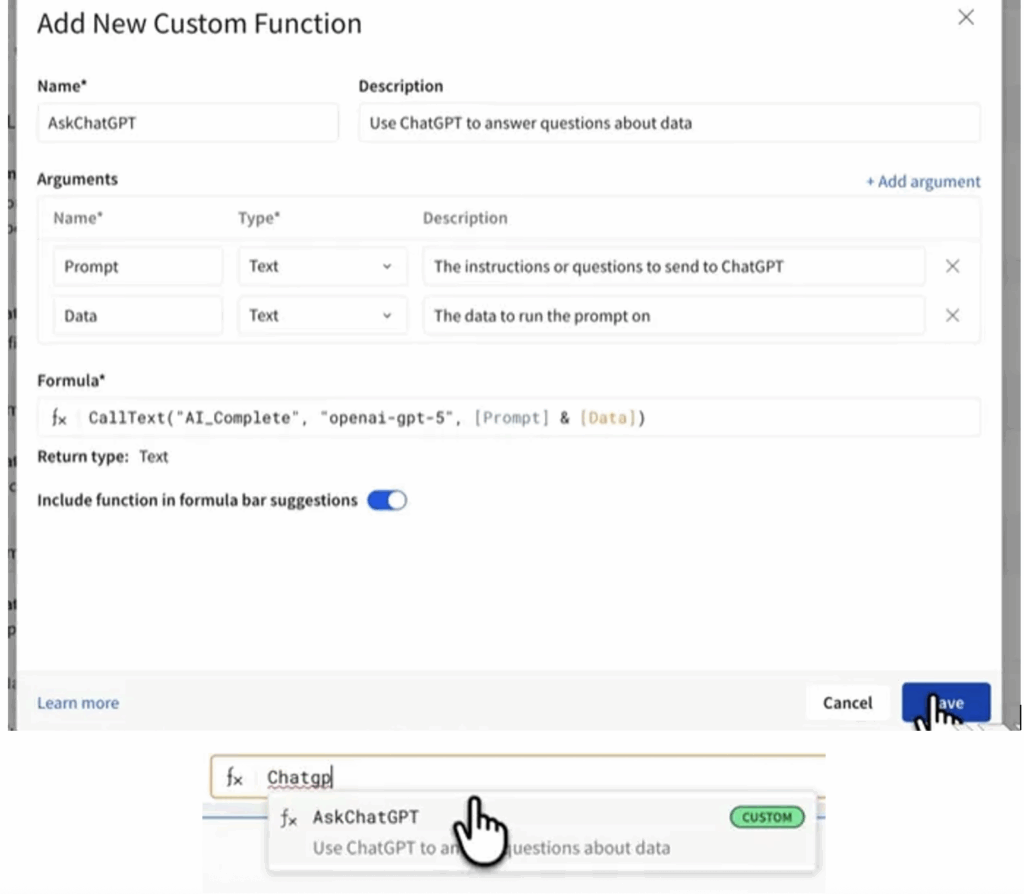
The real value is standardization. Build these custom functions once, and teams across your organization can reuse them without reinventing the wheel.
AI Builder: Your Sigma Copilot
AI Builder, currently in beta, acts as a copilot for creating and iterating on workbooks and apps using natural language. What sets it apart is transparency. You can watch AI Builder’s thoughts, actions and edits as it modifies your workbook, which removes some of the mystery around what the AI is actually doing.
This is a human-in-the-loop approach. AI Builder gives you a starting point, but you can still adjust data validation, layouts, and logic after it runs. Think of it as a way to accelerate prototyping and get past the blank canvas problem rather than a complete hands-off solution.
MCP: Sigma as Client and Server
Sigma is positioning itself within the Model Context Protocol ecosystem in two ways. As a client, Sigma can connect to external content sources through MCP servers like Google Drive, Confluence, GitHub and custom servers with proprietary business data. This content becomes additional context for Sigma’s AI features, so answers can draw from your warehouse data alongside your documentation, code repositories, and knowledge bases.
As an MCP server, Sigma allows external chat interfaces like ChatGPT or Claude to search and pull Sigma content. Instead of sharing static screenshots, external agents can create Sigma elements and workbooks as answers while preserving your security and governance rules. There’s also a Snowflake Cortex Agent integration that lets you plug an agent directly into the Ask Sigma experience.
The takeaway is that Sigma wants to be the UI and orchestration layer connecting your warehouse with AI agents, whether those agents live inside Sigma or in external tools.


Above: Two screenshots from the presentation breaking down Sigma and MCP interactivity.
Tenants: Multi-Tenant Deployments Mature
Sigma Tenants, which launched last quarter, is moving toward public beta with significant improvements. The platform now supports monitoring and observability across hundreds or thousands of tenants, plus cross-region deployments for data residency and latency requirements.
The team is also working on tenant-to-tenant deployment capabilities, which will let you build in a development tenant and push content directly to customer tenants. This should streamline the workflow for teams managing multiple client deployments.
Save the Date: WORKFLOW Conference
Finally, Sigma announced an in-person conference called WORKFLOW on March 5, 2026, in San Francisco. The tagline is “Build workflows. Not workarounds,” and the event targets app builders, data architects and business users.
With AI Query in production, AI Builder in beta, and MCP integration on the horizon, Sigma is making a clear play to become the layer where your data warehouse and AI capabilities meet. The Q4 announcements show a platform that’s maturing quickly while keeping an eye on the governance and transparency concerns that matter in enterprise environments.
